NSER Dynamic Survey
Learn how to complete the NSER Dynamic Survey update for BISP 8171 eligibility. Check your PMT score, avoid verification errors, and secure your stipend today. Tired of seeing an “ineligible” message every time you text your CNIC to 8171? Life moves fast, and if your household data in the National Socio-Economic Registry (NSER) is out of date, the system is likely misjudging your financial reality. Completing the NSER dynamic survey update is the single most important step you can take to unlock or restore your rightful Benazir Income Support Programme (BISP) assistance today.
Also read: BISP 8171 Online Check CNIC 2026 – اہلیت گھر بیٹھے چیک کرنے کا طریقہ
Understanding the NSER Dynamic Survey: Why Your Eligibility Depends on It
If you have ever waited anxiously for a text message from 8171 only to find your Benazir Income Support Programme (BISP) status marked as ineligible or blocked, you are not alone. Behind every financial assistance disbursement lies the National Socio-Economic Registry (NSER), the massive data backbone managed by the Ehsaas and BISP frameworks.
Think of the NSER survey as a financial snapshot of your household. Life changes fast—families grow, children reach school age, utility expenses fluctuate, and economic shocks alter household incomes. If your NSER profile reflects outdated data from years ago, the automated poverty scorecard will misjudge your current reality.
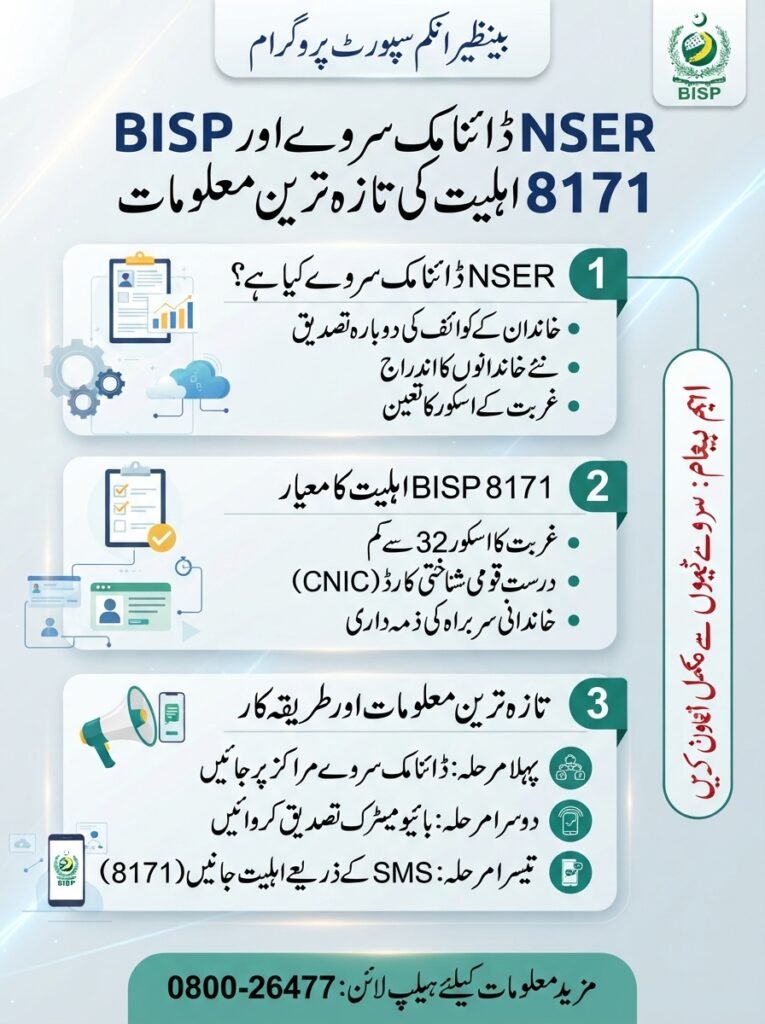
Updating your data through the NSER Dynamic Survey is no longer optional if you want continuous access to welfare support. Unlike older static surveys where representatives visited every door once a decade, the dynamic registry allows you to actively update your socio-economic status at designated registration centers. Let us walk through why this matters and how you can secure your rightful support.
How to Check Your Current BISP 8171 Status
Before rushing to a registration center, you need to know where you currently stand in the system. Checking your eligibility status takes less than a minute, and you have two primary methods to do it securely from home.
How do I check my BISP eligibility by CNIC number?
The fastest way to verify your status is through the official SMS service. Simply open your phone’s messaging app, type your 13-digit Computerized National Identity Card (CNIC) number without any dashes or spaces, and send it to 8171. Within moments, you will receive an automated response detailing your eligibility, whether your payment is ready, or if your record requires an update.
What does an “Ineligible” status on 8171 mean for my household?
Seeing an ineligible message can be discouraging, but it simply means your recorded Poverty Merit Test (PMT) score currently falls outside the qualifying threshold, or your household data is incomplete. Common triggers include having an active bank account transaction history, owning a registered vehicle, or having a family member with a government job. If your financial situation has worsened since your last survey, an ineligible status is a direct signal that you need a fresh NSER dynamic update.
Step-by-Step Guide to Completing the NSER Dynamic Survey Update
Updating your records requires a physical visit because biometric verification and detailed household asset profiling cannot be completed entirely online. Follow these steps to ensure your registration goes smoothly on the first try.
Step 1: Locate Your Nearest BISP Tehsil Office
BISP has established dedicated registration desks inside regional Tehsil offices across every district. You cannot complete a dynamic survey at arbitrary utility stores or makeshift camps; always visit the officially authorized BISP Tehsil center to avoid fraud.
Step 2: Gather All Essential Family Documents
Arriving unprepared is the number one reason applicants get turned away. Make sure you carry:
- Original, valid CNICs of all adult household members.
- Form-B (B-Form) or computerized birth certificates for all dependent children.
- An active, registered mobile number issued under your own CNIC (vital for receiving 8171 alerts).
- Recent electricity or gas utility bills reflecting your current household expenses.
- Disability certificates (if applicable, issued through the Disability Assessment Board via NADRA) to secure special welfare allocations.
Step 3: Complete the Interview and Biometric Verification
Once inside the center, a data entry representative will input your current housing conditions, monthly income, asset ownership, and educational expenses into the digital NSER portal. Afterward, all adult members must complete live fingerprint verification through the NADRA biometric scanners. Double-check every entered detail before signing the final receipt.
What Happens After Your Survey? Decoding the PMT Score and Verification
Many applicants complete the survey and expect immediate cash disbursements. Understanding the back-end processing helps manage expectations and eliminates panic.
How is the BISP Poverty Score (PMT) calculated?
BISP does not look at your income in isolation. Instead, it uses a sophisticated proxy means test algorithm—often called the PMT score—that ranges from 0 to 100. This formula weighs multiple variables simultaneously: per capita income, roof and wall construction materials of your dwelling, drinking water source, toilet facilities, and asset ownership. Households scoring below the federal cutoff threshold qualify for the flagship Benazir Kafalat stipend and associated educational scholarships.
How long does it take for NSER data to update in the 8171 database?
Once your dynamic survey is successfully submitted by the field officer, the data undergoes cross-verification with external databases like NADRA, FBR, and utility providers. This automated data-cleaning process typically takes between two to four weeks. Refrain from repeatedly visiting the office during this window; instead, monitor your status by sending your CNIC to 8171 periodically.
Common Pitfalls That Cause Survey Rejection and How to Avoid Them
Even genuine applicants occasionally face rejection due to minor documentation oversights or technical mismatches during the survey process.
Why do biometric verification failures happen at registration centers?
Faded fingerprints, common among elderly individuals or daily wage laborers, frequently trigger scanner errors. If NADRA scanners fail to read your fingerprints, ask the officer to flag your profile for an alternative verification exception or visit a main NADRA mega-center beforehand to update your biometric thumb impressions.
Can mismatched household information block my stipend?
Yes. Ensure that the head of the household listed during the dynamic survey matches family tree records registered with NADRA. If a married daughter or dependent sibling is listed under multiple independent household registrations simultaneously, the system flags the conflict as a data anomaly, temporarily freezing eligibility for all linked parties.
Frequently Asked Questions
Can I complete the NSER dynamic survey online from home?
No, online portals only allow you to check your existing status via 8171. Actual dynamic data collection requires physical presence, live interviewing, and biometric verification at an authorized BISP Tehsil office.
Is there any fee or registration charge for the NSER survey?
The entire NSER dynamic survey and BISP registration process is 100% free of charge. Report any agents or middlemen demanding cash bribes for fast-tracking your survey to the official BISP helpline.
My children go to school; how do I register for Benazir Taleemi Wazaif?
During your NSER dynamic survey update, inform the data officer about your school-going children. Provide their school admission slips or B-Forms to register them for conditional cash transfer educational stipends automatically.
What should I do if my CNIC has expired?
BISP systems sync directly with NADRA. If your CNIC has expired, your 8171 status will remain blocked until you visit a NADRA center, renew your identity card, and update your records.
How often should a family update their details in the NSER registry?
Families should revisit the Tehsil office for a dynamic update whenever major life events occur, such as marriage, the birth of a child, the death of a family breadwinner, or a permanent change of residential address.