
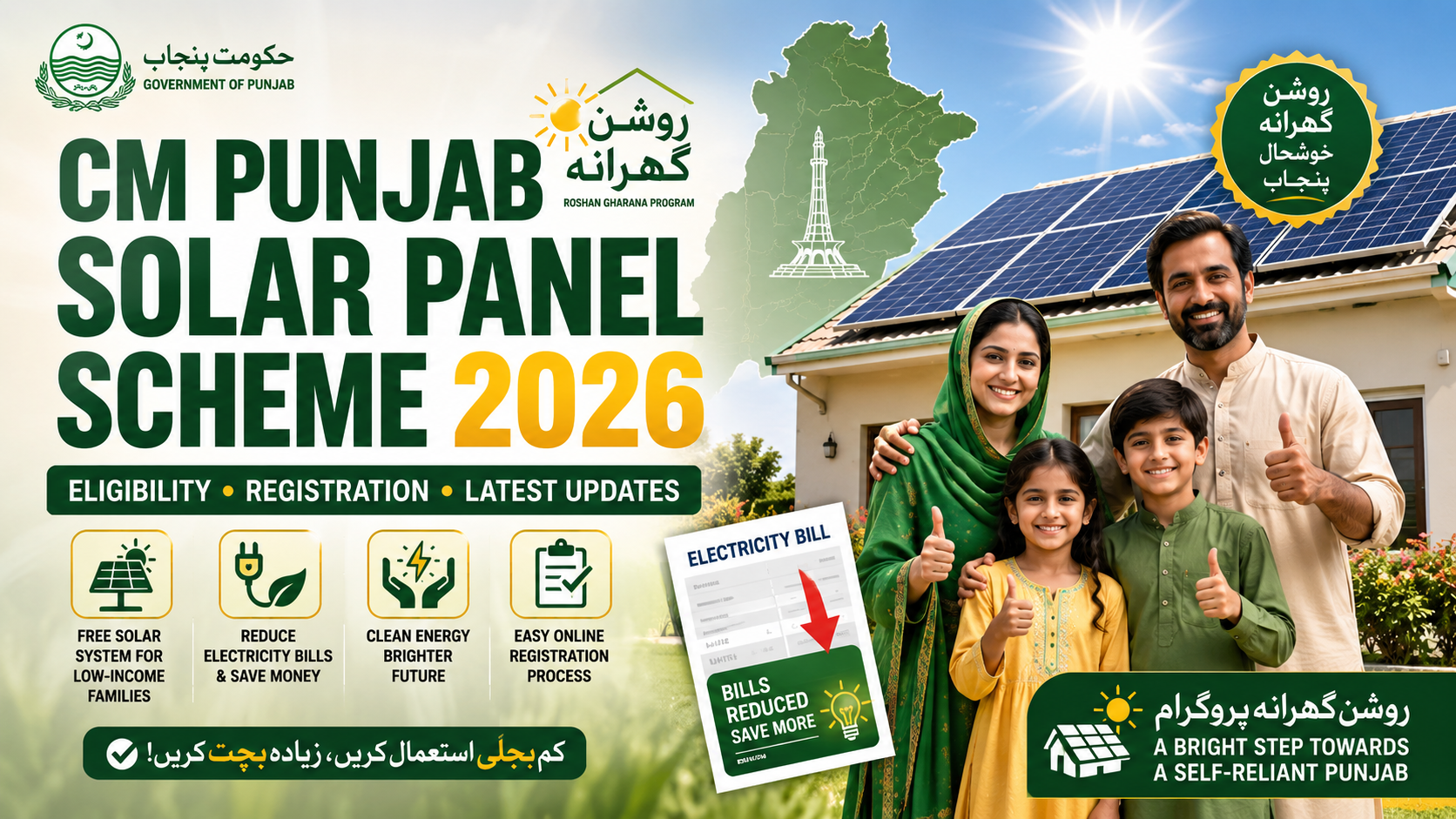
CM Punjab Solar Panel Scheme
Get the latest 2026 CM Punjab Solar Panel Scheme updates. Learn the registration steps, check eligibility, and discover how to apply online today. Soaring electricity tariffs have transformed monthly utility bills from minor household expenses into major financial emergencies across Pakistan. If you are struggling with a sky-high bill, you have likely heard of the Chief Minister Punjab Solar Panel Scheme—formally known as the Roshan Gharana Program. The government has launched this phased clean energy transition initiative to target low-income households and ease the burden on domestic grids. But with so many conflicting rumors online, finding an authentic, actionable update can feel impossible. This deep-dive guide breaks down the actual 2026 ground realities of the CM Punjab Solar Scheme. You will learn who truly qualifies, exactly how the application system operates, and what you will actually receive if selected.
Also read: NADRA New Policy 2026: اب برتھ سرٹیفکیٹ کے بغیر شناختی کارڈ بنوائیں—بڑی تبدیلی آ گئی!
What is the CM Punjab Solar Panel Scheme?
The Chief Minister Solar Program is a targeted provincial relief package structured under the broader Roshan Gharana initiative. Spearheaded by the Government of Punjab, this clean energy initiative aims to provide financial breathing room to low-income domestic consumers.
The underlying concept relies on off-grid decentralization. By moving thousands of low-consumption users off the primary grid during peak hours, the provincial government reduces aggregate baseline power demands. This structural shift addresses seasonal capacity payment pressures on the central power infrastructure.
Unlike standard commercial net-metering installations, this program functions strictly as a socio-economic safety net. The entire infrastructure rollout uses public funds to eliminate upfront technology costs for vulnerable demographics.
Understanding the Roshan Gharana Initiative
The Roshan Gharana initiative serves as Punjab’s core policy framework for distributed generation. The initial phase explicitly aims to equip over 100,000 households with functional solar installations. Rather than spreading the resource pool thin across all user categories, the state prioritizes individuals facing extreme energy poverty.
Free Solar Panels vs. Subsidized Solar Models
It is crucial to understand that the “Muft” (Free) Solar Panel Scheme operates differently from standard green energy financing options. For consumers utilizing less than 200 units monthly, the state provides the equipment as an asset transfer rather than a loan. This contrasts sharply with bank-financed solar loans, which require down payments, monthly markups, and formal equity commitments.
Latest Updates and Phase Status in 2026
The rollout of the CM Punjab Solar Scheme has progressed into an organized, district-by-district deployment phase.
The Shift from Launch to Phased Distribution
The initial application rush saw millions of citizens competing for the initial 100,000 slots. To handle this influx fairly, the Punjab Information Technology Board (PITB) shifted operations to an automated electronic balloting system.
If you have already applied, your tracking ID is grouped inside your localized district quota. Rather than ship all systems simultaneously, teams deploy the setups sequentially by region. This allows local distribution companies (DISCOs) like LESCO, FESCO, and GEPCO to verify localized grid loads before installation.
Current Deadlines and Next Phase Expectations
Phase 1 verification procedures are wrapping up across primary urban and rural sectors. The government plans to open subsequent registry brackets for the next tier of consumers once the first wave of hardware is fully deployed. If your current usage slightly exceeds the active threshold, your application will likely fall under the secondary phase. That phase will introduce partial subsidy structures for mid-tier power users.
Tier 1 vs. Tier 2: System Specifications Broken Down
The program assigns hardware setups using a strict tiered framework tied directly to your proven historical grid usage.
Tier 1: 550W System Specifications
This Tier covers domestic consumers averaging between 0 and 100 units per month over the previous six billing cycles.
- Hardware Bundle: One premium photovoltaic panel rated at 550 Watts, paired with a matching single-phase hybrid inverter, protective rack mounts, and basic DC wiring.
- Actual Capability: A 550W module yields roughly 2 to 3 units of electricity per day under clear atmospheric conditions.
- What It Powers: This output can sustain two standard ceiling fans and four to five low-wattage LED lamps during peak sunlight hours. It cannot run deep freezers, iron presses, or water pumps.
Tier 2: 1,100W System Specifications
This Tier focuses on households consuming between 101 and 200 units per month.
- Hardware Bundle: Two 550W solar panels (delivering a combined capacity of 1,100 Watts), an upgraded hybrid solar inverter, connection wiring, and localized circuit breakers.
- Actual Capability: An 1,100W array produces roughly 4.5 to 6 units of electricity daily, depending on panel angle and cloud cover.
- What It Powers: This tier allows users to run three fans, multiple LED fixtures, and minor low-amp kitchen appliances during midday generation peaks.
Strict Eligibility Criteria for Applicants
Meeting the basic utility limits is only the first step. The verification protocol uses multi-layered data cross-checking to prevent fraud and ensure resources reach the intended recipients.
Who Qualifies for the Free Solar System?
To advance your application to the final balloting round, your profile must align with these mandatory requirements:
- Provincial Residency: The applicant must possess a valid Computerized National Identity Card (CNIC) registered in the province of Punjab.
- Clean Utility Record: You must show a clear 12-month billing history free from formal anti-theft citations, meter-tampering penalties, or chronic payment delinquency.
- Sanctioned Load Limits: The home’s maximum allowed electrical load must sit below 2 kW as recorded by your power company.
- Consumption Ceilings: Your rolling average usage over the past 6 months must stay firmly below the 200-unit line.
Who is Disqualified from the Program?
Applications are automatically rejected by the automated system if they match any of these disqualifying conditions:
- Commercial or industrial connections (the scheme is strictly for domestic residential sites).
- Multiple submissions from different family members using the same electricity reference number.
- Any household with an active monthly power draw exceeding 200 units on any single bill during peak summer months.
Step-by-Step Registration Process
The Punjab government uses a digital-first signup strategy managed by the PITB infrastructure to eliminate middlemen and manual favoritism.
Online Registration
- Preparation: Gather your original CNIC and a physical copy of your latest electricity bill. You will need your 14-digit reference number.
- Access: Open your web browser and navigate to the official portal at [https://cmsolarscheme.punjab.gov.pk](https://cmsolarscheme.punjab.gov.pk).
- Registration: Click the registration option and input your full name, working mobile number, email address, and CNIC.
- Verification: Log in and enter your 14-digit utility reference number. The system will automatically fetch your historical usage data.
- Finalization: Review your details, accept the legal undertaking, and click submit to receive your official tracking number.
The SMS Registration Route
If you lack consistent internet access, you can initiate a basic profile submission via mobile:
- Compose a text with your 14-digit Reference Number followed by a space and then your 13-digit CNIC.
- Send this to 8800.
How the Kissan Solar Tubewell Scheme Helps Farmers
The Roshan Gharana initiative also includes a dedicated parallel branch managed by the Punjab Agriculture Department: The Punjab Solar Tubewell Scheme.
This program offers an 80% subsidy on the total cost of solar tubewell conversions, leaving the farmer to cover only 20%. To apply, farmers must own at least 1 acre of cultivable land and have a functional tubewell bore. Applications are managed through agriculture.punjab.gov.pk.
Frequently Asked Questions
1. Can I run a 1.5-ton AC on the free solar panel scheme?
No. The free systems max out at 1,100 Watts, which is insufficient to handle the startup current of an air conditioner.
2. What if my application is rejected due to a wrong reference number?
Log into the official portal, select your application, and click “Reset Application” to re-enter your 14-digit reference number correctly.
3. Are tenants allowed to apply?
Tenants can apply with formal written consent from the property owner, as the system is permanently linked to the utility meter.
4. What happens if the system is damaged by weather?
Hardware packages include limited manufacturer warranties, but structural damage from storms is typically the homeowner’s responsibility.
5. Is there any monthly fee after installation?
No. For those under 200 units, the system is an asset transfer with no hidden monthly fees or interest.
6. Can I sell the equipment?
No. All equipment is locked to your CNIC, and you are legally prohibited from selling or moving the system for five years.