
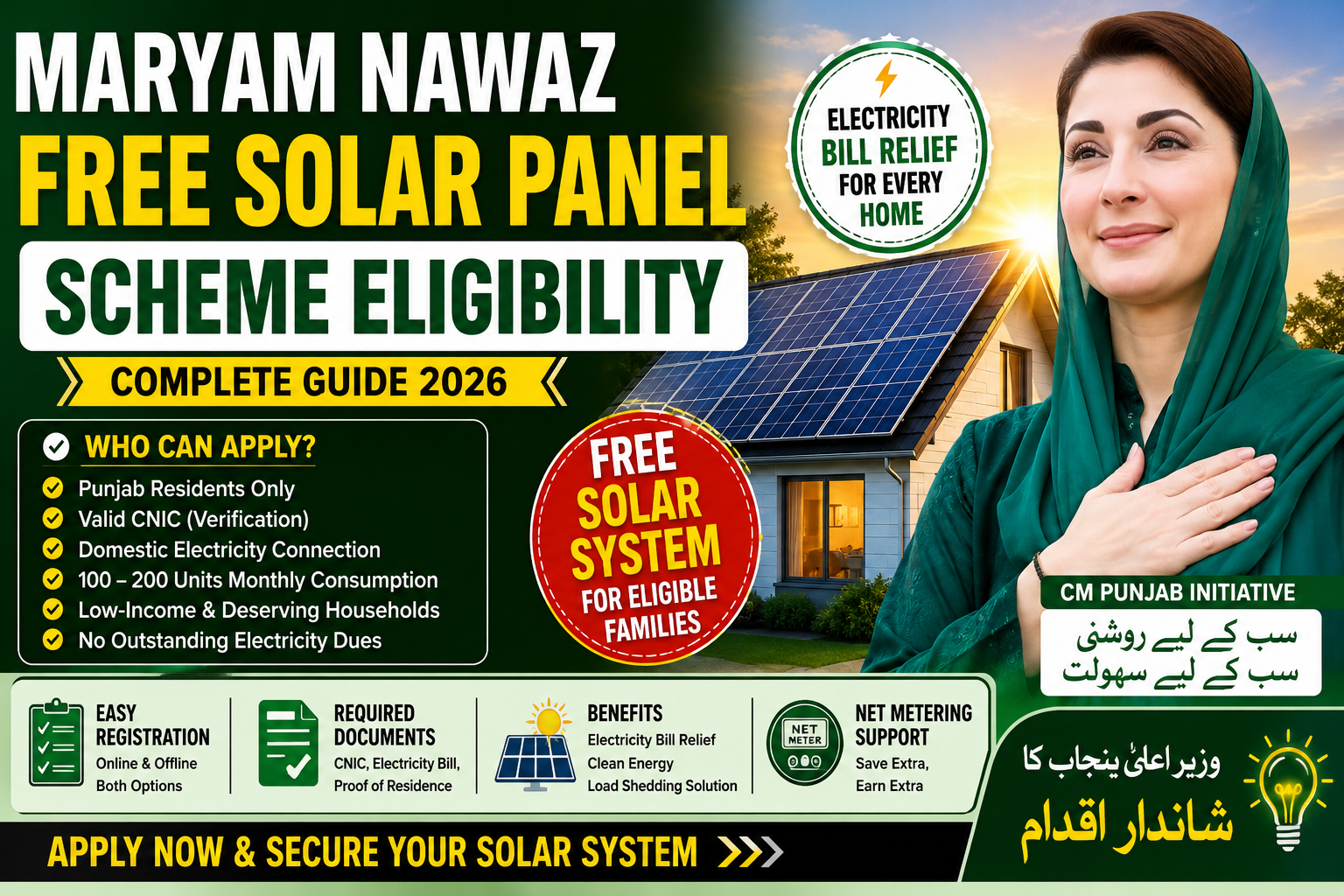
Maryam Nawaz Free Solar Panel Scheme
Pakistan’s electricity bills have become unbearable for many households. That’s exactly why the Maryam Nawaz Free Solar Panel Scheme has gained so much attention across Punjab. The initiative promises relief for low-income families struggling with rising power costs by offering free or subsidized solar systems. But here’s the question most people are asking: Who actually qualifies for the scheme? A lot of applicants rush into registration without understanding the eligibility rules, required documents, or verification process. That leads to rejected applications and confusion. This guide breaks everything down in plain language — from eligibility criteria to application steps, benefits, documents, and common mistakes people make.
Also read: 8171 Web Portal New Update: How to Check Your BISP Payment Status Online
What Is the Maryam Nawaz Free Solar Panel Scheme?
The Maryam Nawaz solar scheme is a Punjab government initiative designed to help households reduce electricity expenses through renewable energy solutions. The focus is mainly on families with lower monthly electricity consumption and limited financial resources.
Under the program, eligible households may receive:
- Free solar panel systems
- Installation support
- Inverters and batteries in some cases
- Subsidized solar solutions for middle-income families
The broader goal is simple: reduce dependency on expensive grid electricity while promoting clean energy in Punjab.
For many rural and semi-urban families, this can be life-changing. A small 1kW or 2kW system can run fans, lights, charging devices, and even basic appliances during long load-shedding hours.
Maryam Nawaz Free Solar Panel Scheme Eligibility Criteria
Understanding the eligibility criteria is the most important step before applying.
Household Electricity Consumption Requirements
The scheme primarily targets households with lower electricity usage.
In most reported guidelines, preference is given to consumers using:
- Around 100–200 units per month
- Domestic electricity connections only
- Registered residential meter holders
Households consuming extremely high electricity units may not qualify for the free category. Instead, they could become eligible for subsidized solar financing options.
Why Low-Consumption Users Get Priority
The government’s strategy focuses on helping families that spend a large percentage of their income on electricity bills.
For example, a family consuming 150 units monthly may spend a painful portion of their earnings just keeping lights and fans running. A basic solar setup can dramatically reduce that burden.
CNIC and Residency Requirements
Applicants generally must:
- Hold a valid Pakistani CNIC
- Be residents of Punjab
- Have a registered electricity connection in their name or close family ownership
Verification usually happens through NADRA and electricity distribution company records.
Can Tenants Apply?
In most cases, tenants face difficulties unless:
- The landlord provides authorization
- The electricity meter is properly documented
- Supporting documents are available
Homeowners typically have a smoother approval process.
Electricity Bill Payment Status
One major factor many people overlook is bill payment history.
Applicants are often expected to:
- Have a clean payment record
- Avoid long-term outstanding dues
- Maintain an active electricity connection
A defaulted or disconnected meter can reduce approval chances significantly.
Income and Financial Status
The scheme is aimed at financially vulnerable households.
Priority may be given to:
- Low-income families
- Beneficiaries registered in social welfare databases
- Families affected by inflation and energy costs
- Rural households with unstable electricity access
Government verification systems may cross-check income data during screening.
How to Apply for the Punjab Free Solar Panel Scheme
The application process is expected to remain mostly digital and verification-based.
Online Registration Process
Applicants generally need to:
- Visit the official Punjab government portal
- Enter CNIC details
- Provide electricity bill reference number
- Submit mobile number verification
- Upload required documents if requested
After submission, applicants receive a tracking or confirmation message.
Offline Registration Options
For people without internet access, facilitation centers may assist with applications.
These can include:
- Local government offices
- Designated registration camps
- Customer service centers
Rural applicants often rely heavily on these physical support channels.
Documents Required for Application
Most applicants should prepare:
- Original CNIC
- Latest electricity bill
- Proof of residence
- Registered mobile number
- Property ownership proof if needed
Common Document Mistakes That Cause Rejections
Many applications fail because of simple issues like:
- Incorrect CNIC numbers
- Expired identity cards
- Unpaid electricity bills
- Mismatched meter ownership
- Blurry uploaded documents
Even a small mismatch between the electricity bill and CNIC can delay approval.
What Benefits Does the Solar Scheme Offer?
The biggest attraction is obvious — lower electricity bills.
But the scheme offers several long-term benefits beyond monthly savings.
Reduced Monthly Electricity Costs
A household using solar energy can reduce dependence on grid electricity during daylight hours.
For many families, that means:
- Lower monthly bills
- Protection from tariff hikes
- Reduced stress during summer months
Some families may eventually cut bills by 50% or more depending on usage patterns.
Backup Power During Load Shedding
Pakistan still faces electricity reliability issues in many areas.
Solar systems help maintain:
- Fans during hot weather
- Basic lighting
- Phone charging
- Internet devices
That matters enormously for students, remote workers, and elderly residents.
Environmental and Economic Impact
Solar adoption also supports broader economic goals.
According to renewable energy experts, decentralized solar systems reduce pressure on the national grid while lowering fuel import dependency.
Pakistan receives abundant sunlight throughout most of the year, making residential solar highly practical compared to many countries with weaker solar exposure.
Who May Not Qualify for the Scheme?
Not every household will be approved.
Several factors may lead to disqualification.
High Electricity Consumption
Families with heavy electricity usage may not fit the low-income relief category.
For instance:
- Large homes with multiple AC units
- Commercial electricity users
- High monthly unit consumption
These households may instead qualify for financing programs rather than free installations.
Commercial Meter Connections
The scheme mainly targets domestic consumers.
Commercial shops, offices, and business connections are usually excluded.
Difference Between Domestic and Commercial Meters
Domestic meters are linked to residential properties. Commercial meters support businesses and typically carry different tariff structures.
This distinction matters during verification.
Incomplete Verification Records
Applications may fail if authorities cannot verify:
- Residency status
- Identity information
- Electricity ownership
- Payment history
Keeping records updated before applying improves approval chances significantly.
People Also Ask About Maryam Nawaz Free Solar Panel Scheme Eligibility
Who is eligible for the free solar panel scheme in Punjab?
Generally, low-income households in Punjab with valid CNICs, active domestic electricity connections, and lower monthly electricity consumption are prioritized.
How many units are allowed for the solar scheme?
Reported eligibility discussions often mention households consuming around 100–200 electricity units monthly. Official limits may vary by program phase.
Is the Maryam Nawaz solar scheme completely free?
Some households may receive fully free systems, while others could qualify for subsidized or installment-based solar options depending on income and electricity usage.
Can government employees apply for the solar scheme?
Eligibility usually depends more on electricity usage and financial criteria rather than profession alone. Verification rules determine final approval.
Can renters apply for the Punjab solar scheme?
Renters may apply, but approval can be harder without property ownership documents or landlord authorization.
What size solar system will beneficiaries receive?
The system size depends on household electricity consumption and government allocation policy. Smaller homes may receive 1kW systems while larger approved households may qualify for bigger setups.
Expert Insights on Punjab’s Solar Initiative
Energy analysts in Pakistan have repeatedly emphasized that small residential solar systems can significantly ease pressure on the national electricity grid.
One practical insight many homeowners miss is energy efficiency. Even with a free solar system, reducing unnecessary appliance usage dramatically improves results.
For example:
- Replacing old fans with inverter models
- Using LED bulbs
- Running heavy appliances during daylight hours
These simple habits maximize solar savings.
Another important point is maintenance. Dust accumulation can reduce solar panel efficiency substantially in Punjab’s climate. Cleaning panels every few weeks helps maintain performance.
Common Misconceptions About the Free Solar Panel Scheme
“Everyone Will Automatically Get Solar Panels”
Not true. The program involves screening, verification, and prioritization.
Applications do not guarantee approval.
“Solar Systems Eliminate Electricity Bills Completely”
Most households still remain partially connected to the grid.
Solar reduces bills significantly, but total elimination depends on:
- System size
- Household usage
- Battery backup
- Net metering setup
“Only Urban Areas Benefit”
Actually, rural households may benefit even more because of frequent power interruptions and weaker electricity infrastructure.
Tips to Improve Approval Chances
Here are practical steps applicants should take before registration:
- Clear any unpaid electricity dues
- Ensure CNIC details are updated
- Verify the meter is registered correctly
- Keep mobile number active
- Submit clear scanned documents
- Apply early during registration windows
People who prepare documentation beforehand usually avoid delays.
Final Thoughts on Maryam Nawaz Free Solar Panel Scheme Eligibility
The Maryam Nawaz free solar panel scheme could become one of Punjab’s most impactful energy relief programs if implemented effectively. For struggling households, solar energy is no longer a luxury — it’s quickly becoming a necessity.
The key is understanding the eligibility rules before applying. Families with low electricity consumption, clean billing records, valid documentation, and genuine residential usage stand the strongest chance of approval.
If you plan to apply, treat the process seriously. Double-check every document, stay updated through official government announcements, and avoid relying on unverified social media claims.
A properly installed solar system can lower electricity costs for years. In today’s economy, that kind of long-term relief matters.
FAQs
What is the main goal of the Punjab solar panel scheme?
The scheme aims to reduce electricity costs for low-income households while promoting renewable energy usage across Punjab.
Do applicants need property ownership documents?
In many cases, yes — especially if meter ownership verification is required.
Will beneficiaries receive batteries with the solar system?
That depends on the package structure announced by the government. Some installations may include batteries and inverters.
Can people with old electricity dues apply?
Outstanding dues may negatively affect eligibility and approval chances.
Is online registration mandatory?
Online registration is usually preferred, but physical facilitation centers may assist applicants without internet access.
Does the scheme support net metering?
Larger systems may potentially support net metering, depending on regulations and technical feasibility.
How long does approval take?
Approval timelines depend on verification, application volume, and installation scheduling.