
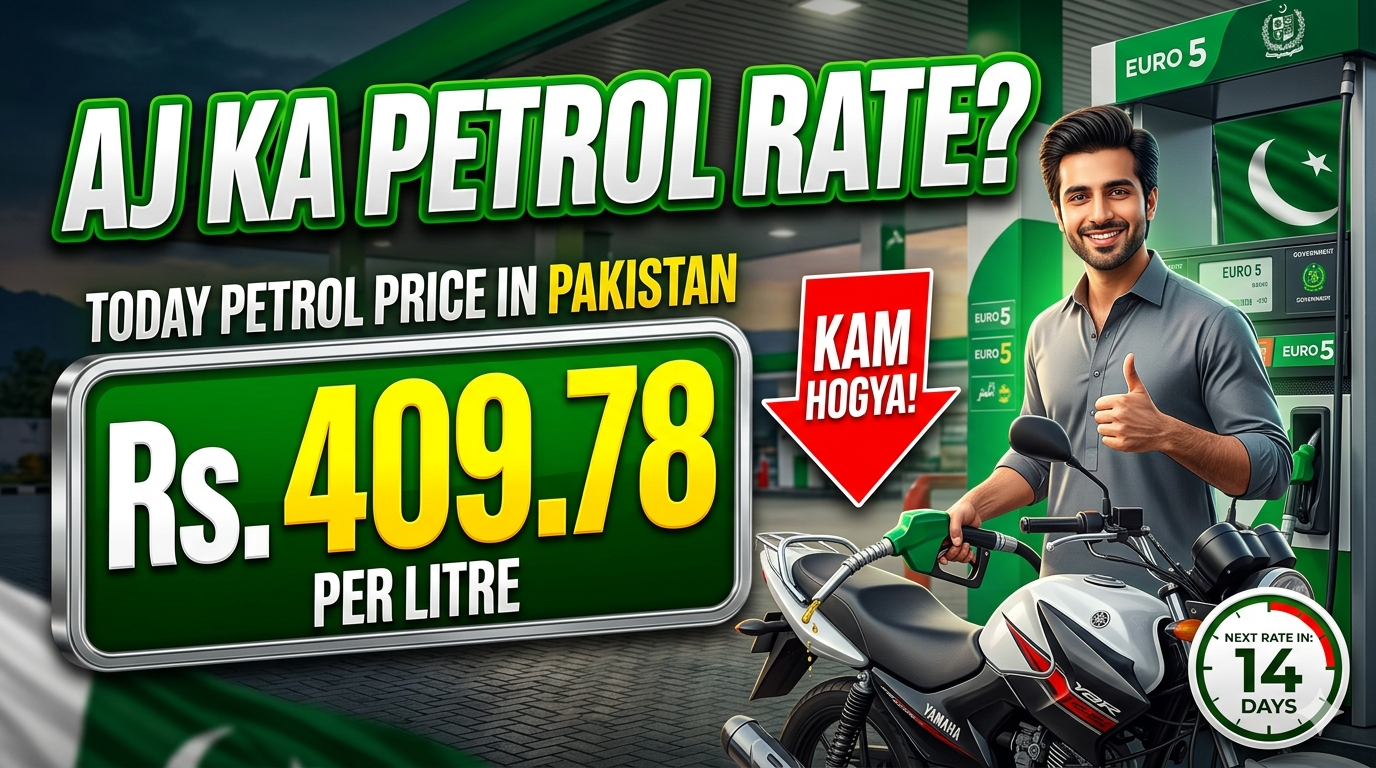
Today Petrol Price in Pakistan Per Litre
Check today petrol price in pakistan per litre. Get the latest verified Euro 5 petrol and diesel rates alongside OGRA pricing insights. Keeping up with fuel costs feels like tracking a rollercoaster that changes direction every fortnight. For the millions of Pakistanis navigating daily commutes, small business logistics, or household budgeting, the question is always front of mind. Following a slight sigh of relief, the federal government officially announced a reduction in petroleum prices, bringing the latest cost of petrol to Rs. 409.78 per litre, while High-Speed Diesel (HSD) mirrors that closely at Rs. 409.58 per litre.
Current Petroleum Prices in Pakistan Across Products
While standard motor spirit gets the lion’s share of media attention, the broader energy market in Pakistan relies heavily on multiple refined oil products. Let us break down what you are paying at the pump right now based on the official Oil and Gas Regulatory Authority (OGRA) notifications.
| Fuel Product | Current Price per Litre (PKR) | Previous Price per Litre (PKR) | Change (PKR) |
| Petrol (Motor Spirit Euro 5) | Rs. 409.78 | Rs. 414.78 | – Rs. 5.00 |
| High-Speed Diesel (HSD) | Rs. 409.58 | Rs. 414.58 | – Rs. 5.00 |
| Kerosine Oil (SKO) | Rs. 311.73 | Rs. 311.73 | Stable |
| Light Diesel Oil (LDO) | Rs. 273.92 | Rs. 273.92 | Stable |
| Hi-Octane 97 (HOBC) | Rs. 445.00 | Rs. 445.00 | Stable |
What is the current price of 1 litre petrol in Pakistan today?
The current price stands firmly at Rs. 409.78 per litre for regular Euro 5 petrol at all standard retail outlets nationwide, including Pakistan State Oil (PSO), Shell, and Total stations. This reflects a clean Rs. 5.00 drop from the previous week’s price of Rs. 414.78.
Is petrol price high or low today?
Compared to the historic peak of Rs. 458.41 per litre witnessed in early April following severe geopolitical flare-ups in the Middle East, today’s price is relatively lower. However, looking at the macroeconomic timeline, the price remains historically high, up substantially from the Rs. 250–260 range seen at the beginning of the year.
The Dynamic Engine Behind Pakistan’s Fuel Pricing Mechanism
Understanding why a litre of fuel costs what it does requires looking far past the local petrol pump. The calculation is governed by an intricate, structured formula that balances international market realities with local fiscal demands.
How does OGRA calculate the price of petrol?
OGRA utilizes an Import Parity Pricing (IPP) framework to determine domestic fuel rates every 15 days. The calculation begins with the base Free on Board (FOB) price of oil, which relies heavily on the Mean of Platts Singapore (MOPS) indexes for refined products rather than just raw Brent crude.
[Base Refined Product Cost]
+ [Ocean Freight & Insurance]
+ [Premium & Port Charges]
= Landing Cost (Ex-Refinery Price)
Once the base ex-refinery cost is locked in, local components are added to the equation. These include the Ocean Freight, incidentals, and the Inland Freight Equalization Margin (IFEM). The IFEM is a critical regulatory mechanism that ensures petrol costs the same whether you are filling up your tank in Karachi or near the border in Peshawar.
Why do fuel rates fluctuate every 15 days?
The government shifted to a fortnightly pricing cycle to prevent oil marketing companies (OMCs) from facing massive inventory shocks and to closely shadow global commodity trends. If Brent crude surges due to global supply choke points, or if the Pakistani Rupee slips against the US Dollar, the impact hits domestic pumps on the 1st or 16th of the upcoming month.
The Triple Threats Behind the High Price Matrix
- The Strait of Hormuz Crisis: Recent escalations involving regional conflicts have disrupted maritime trade routes through the Strait of Hormuz, through which roughly one-fifth of the world’s petroleum passes. This pushed international crude toward the $126 per barrel mark.
- Currency Devaluation Adjustments: Because Pakistan imports over 80 percent of its crude oil and refined energy products, any weakness in the PKR directly inflates the base import cost.
- The Petroleum Levy (PL): To meet strict fiscal consolidation targets under ongoing international monetary programs, the government maintains a steep regulatory tax on petroleum products.
Regional Fuel Tariffs: Does Location Matter?
One common question among local drivers centers on whether regional taxes alter what you pay from province to province.
Base Price (Ex-Refinery) + Taxes + Margins + IFEM = Uniform Nationwide Price
Is petrol price the same in Lahore, Karachi, and Islamabad?
Yes, the standard retail prices for regular Euro 5 petrol and High-Speed Diesel are uniform across all major cities due to the IFEM system. Whether you pull into a station in Lahore, Karachi, Islamabad, or Multan, the baseline regulated rate remains Rs. 409.78 per litre.
The High-Octane Exception
While standard fuel stays uniform, premium fuels like Hi-Octane 97 (HOBC) are deregulated. OMCs are permitted to set independent margins on premium variants based on localized logistics. As a result, you might find Hi-Octane priced around Rs. 445.00 per litre in major transport hubs, but it can fluctuate slightly at remote highway service stations.
The Broader Impact of Rs. 400+ Fuel on the Economy
When the cost of a fuel litre crosses key psychological thresholds, the ripples are felt far beyond the transportation sector. It behaves like a master switch for the entire national cost of living.
How does petrol price affect inflation in Pakistan?
Fuel is a primary input cost for everything from agricultural tractors harvesting wheat to trucks transporting consumer goods across the country. Whenever petrol or diesel rates tick upward, transport cartels and logistics providers instantly pass the burden onto retailers. This creates a cascading inflationary effect on daily essentials like milk, vegetables, and meat.
The Direct Hit to the Household Budget
For the average commuter driving a standard 70cc or 125cc motorcycle, or a small family operating an 800cc hatchback, the monthly fuel bill has transformed from a minor operational expense into a major line item.
Consider a typical office worker traveling 40 kilometers daily for 22 working days a month:
- Motorcycle Commuter (Avg 40 km/l): Consumes roughly 22 litres a month, translating to nearly Rs. 9,000 in fuel costs alone.
- Hatchback Driver (Avg 16 km/l): Requires roughly 55 litres monthly, pushing the bill over Rs. 22,500.
- Sedan Owner (Avg 12 km/l): Burns through roughly 73 litres, resulting in a staggering Rs. 30,000+ monthly expense.
This immense budgetary pressure is actively reshaping urban commuting trends, causing a historic surge in carpooling networks and driving rapid consumer interest toward electric two-wheelers.
Smart Fuel-Saving Strategies to Protect Your Wallet
With fuel prices hovering near historic highs, changing how you drive is the fastest way to give yourself a localized subsidy.
Optimize Your Driving Technique
Aggressive driving, characterized by rapid acceleration and hard braking, can slash your fuel efficiency by up to 33 percent on highways and 5 percent in stop-and-go city traffic. Practicing progressive throttle control and reading the traffic ahead allows the engine to operate within its optimal RPM band.
Keep Up with Preventive Vehicle Maintenance
Mechanical health dictates fuel consumption. Ensuring your tires are inflated to the exact manufacturer-recommended PSI can improve mileage by up to 3 percent. Regularly replacing clogged air filters, using the correct viscosity grade of engine oil, and cleaning dirty fuel injectors can collectively boost your vehicle’s fuel economy by 10 to 15 percent.
Frequently Asked Questions
Which authority decides fuel prices in Pakistan?
The Oil and Gas Regulatory Authority (OGRA) computes the cost breakdown based on international market pricing and domestic taxes. It submits its formal recommendations to the Ministry of Energy (Petroleum Division), which issues the final approval in coordination with the Prime Minister.
What is the petroleum levy on petrol in Pakistan right now?
The petroleum levy is a fixed statutory tax applied per litre to meet federal revenue targets. While it maxed out near Rs. 60–80 during fiscal crunches, the current levy is adjusted dynamically by the federal government to stabilize retail prices when international crude surges.
Why is diesel often priced differently than petrol?
High-Speed Diesel is heavily utilized by the commercial transport sector, heavy freight trains, and agricultural machinery. Because diesel directly controls the cost of food transport and farming logistics, the government occasionally applies a different tax structure or levy to HSD to safeguard the agricultural economy.
Does the quality of fuel vary between different fuel companies?
All registered OMCs in Pakistan are legally required to distribute fuel that meets minimum Euro 5 emissions standards as regulated by the state. However, variation can occur at individual, poorly monitored retail stations due to tank contamination or fuel tampering. It is best practice to fill up at company-operated, high-volume stations.
When will the next petrol price review happen?
The government reviews petroleum product rates on a strict fortnightly schedule. The next price evaluation will be calculated and formally announced late at night on May 31, with the new rates taking legal effect nationwide at exactly 12:00 AM on June 1.
Actionable Takeaway for Consumers
The constant shifting of fuel rates is a firm structural reality tied directly to global energy supply lines and national revenue targets. While today’s price reduction to Rs. 409.78 per litre offers a brief operational window of relief, long-term volatility remains highly likely given current international market pressures.
Instead of trying to outguess the next fortnightly notification, focus on variables you can directly control. Audit your weekly travel, optimize your vehicle’s mechanical health, and restructure your commuting habits around high-efficiency practices to insulated your household finances against upcoming energy shocks.