
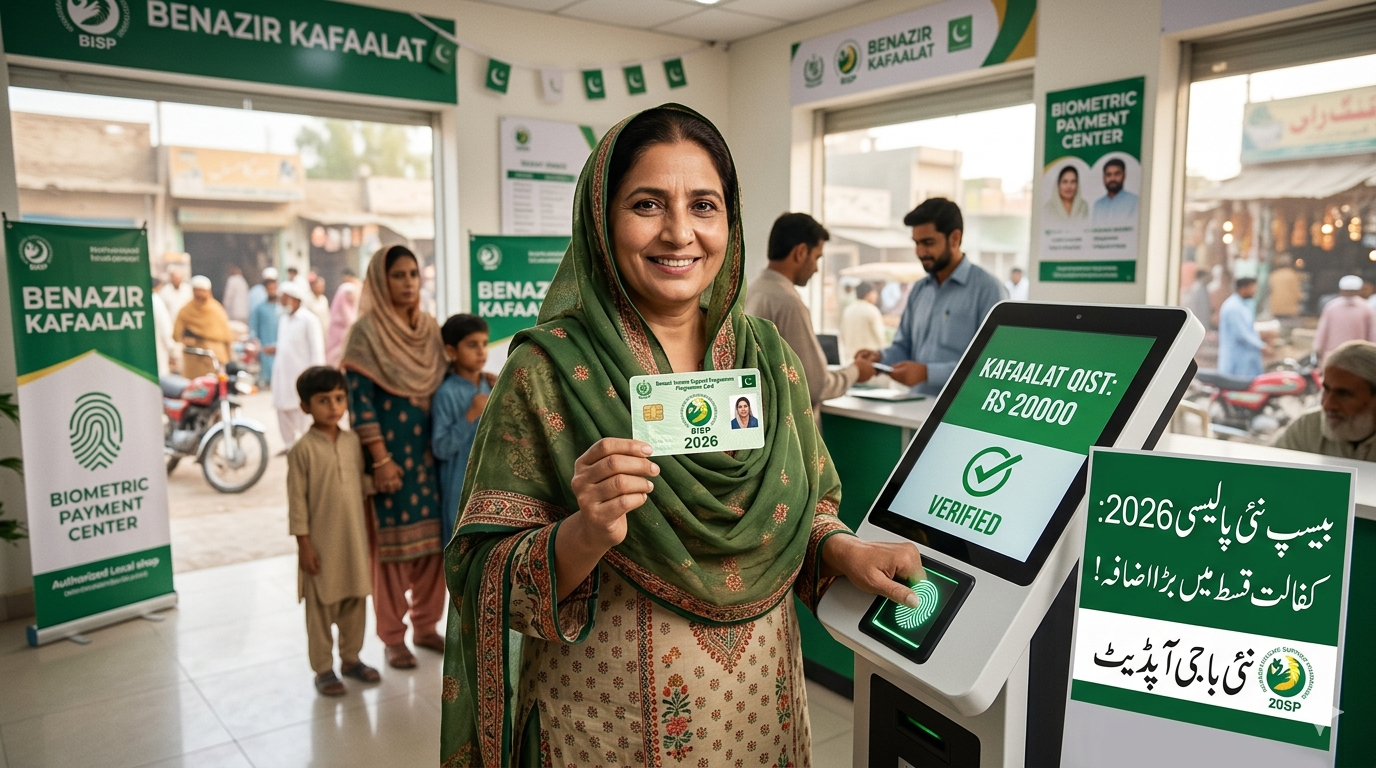
BISP New Policy 2026
The Benazir Income Support Programme (BISP) has officially rolled out its updated operational framework for the fiscal year 2026. This comprehensive structural shift introduces a substantial budget expansion alongside a modernized cash disbursement model across Pakistan. Driven by a 20% year-on-year budgetary surge to Rs 716 billion, the primary objective of this reform is to cushion low-income households against persistent inflationary pressures while improving transparency in financial delivery. For registered beneficiaries and those aiming to clear their eligibility status via the 8171 portal, understanding these policy transitions is critical. This guide breaks down the core structural adjustments, the verified stipend increase, the operational mechanics of the “Nayi Baji” retail payment model, and the steps required to secure your regular financial support.
Also read: Big Relief for Pensioners 2026: Government Announces Major New Initiative For Employees
The 2026 BISP Structural Overhaul: What Changed?
The core architecture of BISP has transitioned from a basic cash-transfer system into a targeted socioeconomic safety net. Under the framework developed for 2026, the program integrates data-driven verification mechanics to eliminate ghost beneficiaries and streamline the flow of state capital to vulnerable segments.
The Rs 716 Billion Budget Expansion
The government has scaled the comprehensive BISP financial pool to Rs 716 billion. This funding influx directly fuels the baseline expansion of the Benazir Kafaalat initiative. It ensures that cash liquidity remains stable throughout the multi-tiered quarterly distribution phases across all regional administrative zones.
IMF and World Bank Joint Alignment Framework
A key pillar of the 2026 policy framework is its strict alignment with international fiscal guidelines. Working alongside global advisory bodies, BISP has refined its registry indexing. The program utilizes an updated Proxy Means Test (PMT) threshold to map consumer profiles, combining national power sector data with social safety registries to establish precise poverty mapping scores.
Benazir Kafaalat Qist: Breakdown of the New Payment Scale
The baseline financial allocation for the Benazir Kafaalat installment has been adjusted upward to match the rising cost of basic commodities. This adjustment ensures that the real purchasing power of vulnerable households does not deteriorate.
Quarterly Cash Tranche Adjustment
The regular quarterly cash tranche has officially increased, shifting baseline household payouts to a higher tier compared to previous deployment phases. This ensures that beneficiaries receive an expanded cushion during regular distribution cycles.
Regional Tiered Allocations
To maximize equity, the financial deployment framework incorporates special regional provisions. While the national baseline remains uniform, targeted premium adjustments apply to specialized zones, including parts of Balochistan, rural Sindh, and Khyber Pakhtunkhwa. These adjustments account for the increased transport costs incurred by beneficiaries traveling to retail banking centers.
How Can I Check My Eligibility on the 8171 Portal?
Beneficiaries can verify their financial status by executing a simple lookup against the national identity registry. The process is fully digitized to bypass middlemen and ensure direct data transparency:
- Launch a secure web browser and access the official web portal at 8171.bisp.gov.pk.
- Input the 13-digit Computerized National Identity Card (CNIC) number into the designated form field without hyphens.
- Transcribe the unique four-digit verification captcha security code displayed on screen.
- Click the submission button to return a real-time status log showing eligibility flags, current balance tranches, and registration dates.
Understanding the “Nayi Baji” Retail Payment Model
The biggest operational shift in 2026 is the complete sunsetting of outdated, centralized cash camps. In their place, the “Nayi Baji” retail framework shifts transactional power back to local communities through a decentralized partner-banking network.
Decentralized Cash Point Deployments
Instead of traveling to congested dedicated distribution fields, beneficiaries can now access their cash assets directly through local retail networks and commercial banking points. This transition utilizes thousands of biometric-enabled retail shops and dedicated local agents across sub-districts, reducing transit overheads for rural families.
Biometric Verification Integrity Protocols
To eliminate transaction fraud, cash release requires live verification. Every payout requires a successful biometric thumbprint verification matched directly against the National Database and Registration Authority (NADRA) core database.
What is the Step-by-Step Retail Collection Method?
To collect funds through the modernized distribution grid, registered heads of households must follow a specific sequence:
- Step 1: 8171 Notification Arrival: Wait for an official SMS confirmation originating strictly from the short-code “8171”. Do not act on communications received from standard mobile numbers.
- Step 2: Local Point Identification: Visit an authorized partner bank retail shop or a verified biometric distribution counter within your district.
- Step 3: Document Submission: Present your original, unexpired physical CNIC card to the device operator. Digital copies or printouts are not accepted.
- Step 4: Biometric Matching: Place your right thumb or designated index finger on the optical scanning device to authorize database matching.
- Step 5: Full Payout Collection: Demand the exact balance amount shown on the transaction receipt. Ensure that the agent does not deduct any service fees or hidden handling charges, as the program mandates zero-cost retail collection.
Mandatory System Updates: Dynamic Survey Registration
Continuity of financial support is no longer automatic. The new policy mandates periodic lifecycle updates to the National Socio-Economic Registry (NSER) via local BISP facilitation centers.
The 2026 Dynamic Survey Requirement
Every registered family must undergo an asset and income re-evaluation via a dynamic survey window if their registration has crossed the three-year mark. This update tracks changes in household dependency ratios, asset acquisitions, or shifts in monthly utility consumption metrics.
Biometric and SIM Registration Synchronization
A major update in the 2026 framework is the strict alignment of cellular assets. The mobile SIM card utilized by the beneficiary must be registered under the exact same CNIC number listed in the BISP central database. Discrepancies between biometric SIM ownership and registered household identities will cause system flags, delaying or pausing future tranches.
How Do I Re-Register If My BISP Status Appears Inactive?
If your profile returns an “Inactive” status on the 8171 lookup grid, you can reset your registry access by following this procedure:
- Visit your nearest dedicated BISP Tehsil Office with all dependent household documentation.
- Present original CNICs for adults and official B-Forms issued by NADRA for all underage children.
- Request a fresh NSER Dynamic Survey interview from the counter official.
- Provide precise, verifiable metrics regarding household monthly income, land ownership status, and average electricity consumption.
- Complete the processing stage by submitting your biometric signature on the digital terminal, initiating a tracking ID for a 60-day background validation cycle.
BISP Program Integration Matrix for 2026
The core Kafaalat cash tranche acts as a foundational anchor for several secondary welfare programs. Eligible families can stack multiple benefits depending on their specific household demographics.
| Integrated Sub-Program | Primary Focus | Monthly/Quarterly Benefit Structure |
| Benazir Taleemi Wazaif | Child Education Retention | Tiered quarterly stipends based on school level, with specialized premium bonuses for female students. |
| Benazir Nashonuma | Maternal & Infant Health | Focused nutrition kits alongside conditional cash support for pregnant and lactating mothers up to 24 months. |
| Targeted Power Rebates | Energy Utility Subsidy | Integrated electricity bill rebates linked directly to the lower PMT score spectrum. |
Frequently Asked Questions
Why has my BISP account been blocked under the 2026 policy?
Accounts are typically flagged due to a failure to complete the mandatory NSER dynamic survey within the specified three-year window, or because of asset detection flags, such as high utility bills or foreign travel records linked to the registered CNIC.
What should I do if a retail agent demands a fee during cash collection?
BISP mandates zero fees for cash collection. If an agent tries to deduct money, file an immediate official report through the BISP toll-free helpline (0800-26477) or lodge a formal complaint at your local Tehsil office with the retail point’s agent ID.
Can unmarried or widowed women apply for the 2026 Kafaalat program?
Yes. Widows, divorced women, and single women over a specific age bracket are eligible for priority profiling, provided they hold a valid NADRA CNIC showing their updated marital status.
How long does it take for NSER survey data to process?
After completing a new dynamic survey at a Tehsil office, the data undergoes rigorous automated checks. The review process generally takes between 60 to 90 days before an updated eligibility status reflects on the 8171 portal.
What should I do if my fingerprints do not match the retail device?
If your biometric verification fails multiple times at a retail point, visit your nearest NADRA office for fingerprint revitalization, or use the dedicated BISP desk to request a specialized commercial bank verification bypass method.
Actionable Strategy for Beneficiaries
To ensure long-term stability within the BISP grid under the 2026 policy framework, prioritize these three steps:
First, run your CNIC on the 8171 portal to confirm that your profile does not require an immediate NSER survey refresh. Second, verify that the mobile number receiving BISP notifications is registered in your name at your cellular network provider. Finally, keep track of your transaction receipts from retail points to ensure you receive your full, updated stipend without any illegal deductions.