
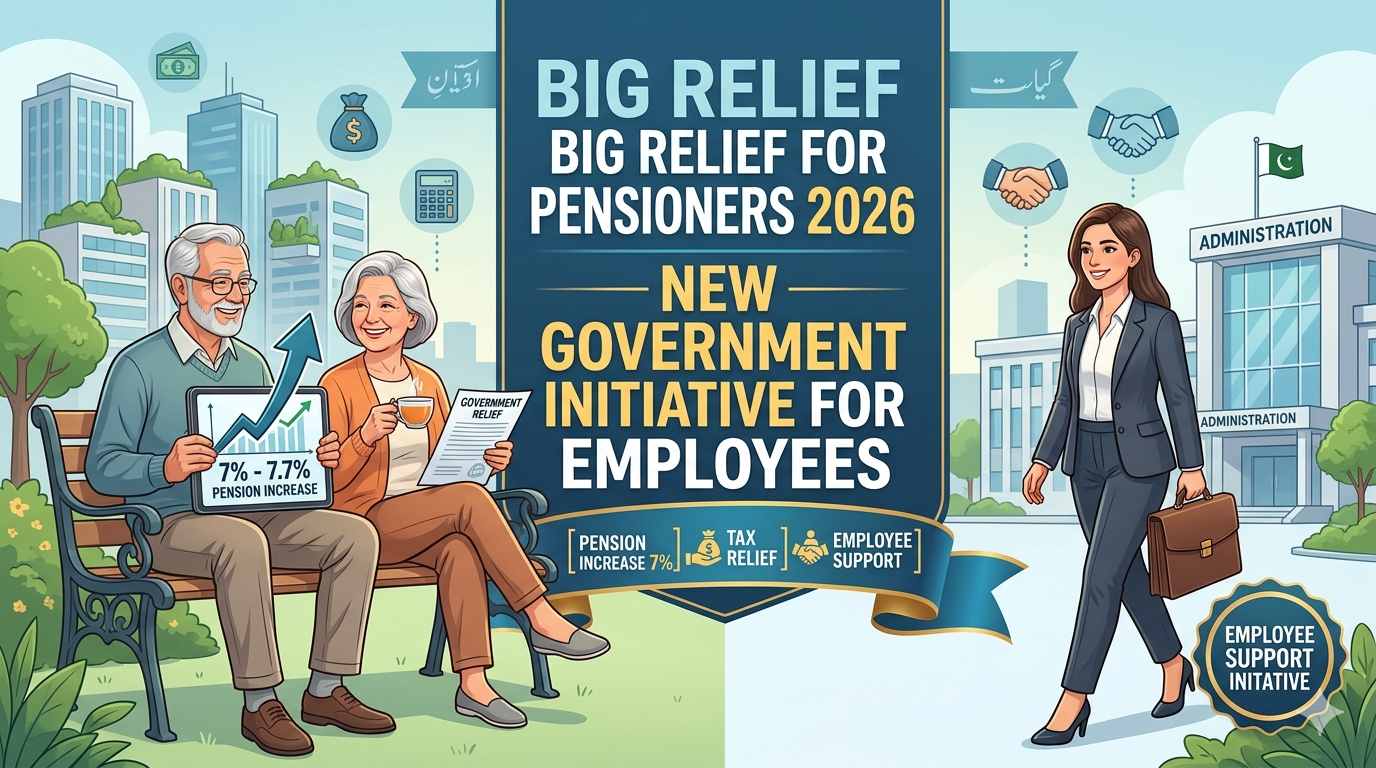
Big Relief for Pensioners 2026
For years, retired public sector workers and long-serving employees have watched their purchasing power steadily erode. The quiet anxiety of balancing a fixed retirement income against volatile market realities is a challenge millions understand all too deeply. But a major shift has arrived. The newly announced fiscal package delivers a substantial wave of financial structural changes tailored explicitly to safeguard aging citizens and support active public servants. This sweeping state-backed program is more than a temporary subsidy; it represents an overhaul designed to modernize public welfare, adjust payout slabs, and offer tangible financial breathing room. Let’s break down exactly what these changes mean for your monthly budget, your retirement timeline, and your family’s financial security.
Also read: Mehngai Se Pareshan Awam Ke Liye Barhi Khabar: Hukumat Ka Sasti Roti Aur Utility Relief Package
The Core Framework of the 2026 Pension and Employee Initiative
The newly unveiled state initiative directly addresses the structural vulnerabilities embedded within our public sector retirement systems. At its foundation, the policy targets two distinct groups: active public sector employees preparing for their future, and senior citizens currently drawing monthly retirement payouts.
Rather than relying on a one-size-fits-all bonus, the treasury has deployed a tiered allocation strategy. For active workers, the focus centers heavily on payroll tax rationalization and career-end gratuity restructuring.
For existing retirees, the policy introduces immediate, direct upward adjustments to flat-rate payouts. This dual-track approach ensures that while senior citizens receive a vital shield against ongoing economic pressures, active personnel can build healthier personal savings pools before they formally exit the workforce.
What are the key features of the Big Relief for Pensioners 2026?
The core of the initiative relies on a standardized baseline increase coupled with targeted tax optimization. Specifically, the government has formalized a mandatory 7% to 7.7% baseline increase in regular monthly pension disbursements across multiple jurisdictions.
Beyond the direct cash adjustments, the policy drastically revises standard tax brackets for salaried individuals. By expanding the existing income slabs from six to eight distinct tiers, the government has successfully flattened the tax curve for middle-income workers. This means active employees can retain more net pay each month, reducing their dependency on future retirement loans.
How does this year’s initiative differ from previous government relief programs?
Historically, financial updates for retirees consisted of flat, ad-hoc bonuses that were rapidly swallowed by market fluctuations. The 2026 initiative breaks that cycle by embedding a structural tax relief package right alongside the baseline increment.
For instance, high-income earners face re-calibrated surcharges, while the middle tier enjoys relaxed withholding requirements on digital financial transactions. Furthermore, by linking public sector structural hikes directly with targeted social safety nets—such as expanded regional healthcare card programs—the state is offsetting basic living costs without putting all the pressure on flat cash distributions.
Direct Financial Impact: Payout Adjustments and Tax Slabs
When you strip away the dense administrative terminology, what people truly care about is the bottom-line change to their bank accounts. The 2026 policy approaches this from two mathematical angles: increasing incoming cash flow and reducing mandatory outgoing deductions.
Under the new 2026 fiscal adjustments, public sector pensions will see a baseline increase of 7.0% to 7.7%, while the federal minimum wage receives a 10.0% structural lift. At the same time, income tax slabs are expanded from 6 to 8 for better rationalization, and the withholding tax on foreign card transactions is slashed from 5.0% down to 0.5%.
This structural shift provides a significant cushion for household balance sheets. By spreading the adjustments across multiple financial levers, the state avoids over-indexing on any single mechanism, creating a more sustainable relief model.
Who is eligible for the new 2026 pension increases?
Eligibility extends universally across all certified federal retirees, alongside corresponding provincial departments adopting the updated fiscal framework. If you are a retired public sector worker drawing an official state pension, the updated baseline percentage applies directly to your core monthly entitlement.
Additionally, current employees looking toward retirement benefit from adjusted gratuity protections and lower tax withholding limits. This ensures that the financial transition out of full-time public employment is far less jarring than it was under older fiscal codes.
What are the newly adjusted income tax slabs for public sector employees?
The restructuring of tax brackets represents a major victory for the salaried class. The historical six-slab model often forced middle earners into disproportionately high tax brackets. The new eight-slab configuration offers a much smoother tax progression:
- Annual incomes between Rs. 2.2m and Rs. 3.2m are now capped at a 20% maximum rate (down from 23%).
- Earnings between Rs. 3.2m and Rs. 4.1m drop to a 25% rate (previously 30%).
- The bracket spanning Rs. 4.1m to Rs. 5.6m enjoys a reduced 29% rate (down from 35%).
- Incomes between Rs. 5.6m and Rs. 7.0m settle at a 32% maximum instead of the old 35% cliff.
Only individuals earning well above the Rs. 7.0m threshold are subject to the peak 35% rate, drastically freeing up monthly disposable income for the vast majority of professionals.
Microeconomic Pressures: Inflation vs. Real-Term Benefits
While a 7% bump in monthly payouts sounds excellent on paper, any seasoned financial strategist must weigh these figures against the broader economic landscape. We have to look honestly at how these adjustments hold up when raw market inflation is factored into the equation.
Independent financial analysis indicates that market inflation is projected to average roughly 8.2% over the coming fiscal cycle. Because this structural rate sits slightly above the nominal 7% pension increase, the real-term purchasing power gains will be highly defensive rather than expansive.
What this means in plain terms is that the initiative acts primarily as a vital economic shield. It prevents a catastrophic drop in your household standard of living, keeping seniors anchored safely even as consumer goods prices experience upward pressure.
Will the 2026 pension increase keep pace with current inflation rates?
Strictly speaking, the nominal increase acts as a stabilizer rather than a true wealth generator. Because the baseline increase hovers just underneath the projected inflation line, retirees will still need to practice careful budgetary management.
However, the state has smartly offset this narrow margin by slashing duties and sales taxes on foundational items. Eliminating overhead costs on over 100 essential raw materials for critical healthcare and cancer medications dramatically lightens the financial burden on senior households, where medical costs typically eat up a huge percentage of the monthly budget.
How does the 2026 initiative safeguard the purchasing power of seniors?
Beyond direct monetary adjustments, the state is protecting older citizens by aggressively cutting down operational transaction friction. For example, reducing the withholding tax on international debit and credit transactions from 5% to a minimal 0.5% removes heavy operational penalties for families receiving support from relatives abroad or managing digital payments.
Combined with localized expansions in provincial welfare funds and dedicated social safety networks, the framework helps insulate vulnerable households from sudden spikes in basic commodity pricing.
Administrative Timelines, Logistics, and Next Steps
An initiative of this size is only as good as its deployment strategy. To avoid administrative bottlenecks, the treasury has mandated clear, strict implementation schedules across all processing networks and banking institutions.
Phase 1: June Execution — Treasury Authorization and SRO Issuance
The Ministry of Finance issues formal Statutory Regulatory Orders (SROs) to clearinghouses and central banking institutions, legally cementing the new tax slabs and baseline pension rates.
Phase 2: Early July Transition — Banking System Updates and Payroll Calibration
Commercial and state banks update their automated disbursement ledgers. Active employee payroll accounting modules switch over to the newer 8-slab tax calculation formulas.
Phase 3: July Billing Cycle — Retiree Verification and Adjustments
Retirees check their standard accounts during the initial July payment cycle. The mandatory baseline increase reflects automatically on official state payment stubs without requiring manual registration.
Phase 4: August Onward — Audit and Discrepancy Reconciliation
Regional accounting departments run comprehensive audits to catch and correct any local payroll anomalies or missing adjustments, ensuring zero omission across departments.
When will eligible individuals begin receiving increased pension payments?
The updated disbursements are legally scheduled to take effect at the start of the upcoming fiscal term, with the primary changes appearing directly in the July payroll cycles. Because these baseline increases are hardcoded directly into the central treasury disbursement systems, eligible individuals do not need to submit complex paperwork or navigate frustrating bureaucratic channels to activate their new rates.
What should employees do if their monthly tax deductions are calculated incorrectly?
If your initial pay cycle does not accurately mirror the lower percentages outlined in the newly established eight-slab tax model, your first step should be contacting your internal corporate or departmental payroll team.
Ensure your payroll department has integrated the updated Ministry of Finance structural guidelines. If discrepancies persist, employees can flag the issue directly through their state revenue authority’s online portal to secure rapid, retroactive adjustments.
Actionable Strategy: Maximizing Your 2026 Retirement Benefits
An increase in income is only as effective as the strategy behind how you manage it. With the state introducing both direct baseline bumps and significant tax relief, public sector employees and retirees have a prime window to optimize their household finances.
- Reallocate the Tax Savings: If you are an active employee tracking within the newly relaxed tax brackets, do not simply absorb that extra cash into daily impulse spending. Direct those newly recovered funds straight into compounding retirement accounts or low-risk state bonds.
- Audit Your Medical Overhead: With the wholesale removal of duties on critical healthcare materials and cancer medications, sit down with your healthcare provider. Audit your recurring prescription costs to ensure you are utilizing newly exempted, lower-cost medical options.
- Leverage Lower Digital Fees: Take advantage of the reduction in transaction taxes (down to 0.5%). Move away from cash-intensive, high-fee traditional money transfers and utilize secure digital bank channels to handle your family payments seamlessly.
The Strategic Path Forward for Public Service Professionals
The 2026 pension and employee relief package offers an essential corrective step toward economic stabilization. While it may not entirely outpace macro inflation, the combination of a solid 7% baseline increase, a highly rationalized eight-slab tax structure, and targeted healthcare exemptions provides a dependable safety net for those who have spent their lives serving the public.
By proactively understanding these regulatory updates and re-centering your personal savings plans around the new tax brackets, you can transform these policy changes into true, long-term financial security. Keep a close eye on your upcoming July pay stubs, update your family budgets accordingly, and make these state-backed initiatives work explicitly for your future.
Frequently Asked Questions
What is the exact percentage increase for pensioners in 2026?
The initiative introduces a mandatory baseline increase ranging between 7% and 7.7%, depending on specific regional and federal departmental classifications.
How do the new eight tax slabs benefit middle-income public employees?
By breaking down the old six-slab system into eight distinct brackets, the tax curve flattens significantly. This allows individuals earning between Rs. 2.2m and Rs. 7.0m to keep more of their hard-earned money by lowering their maximum tax rates by as much as 3% to 6%.
Do retirees need to apply manually to receive the 2026 pension increase?
No. The baseline adjustments are integrated directly into the central state treasury and automated clearing banking networks, meaning your updated payout will reflect automatically starting in July.
Are private sector employees covered under this 2026 relief package?
The primary baseline pension increases and gratuity restructurings apply strictly to public sector retirees and government employees. However, private sector workers still benefit significantly from the broader revisions to the national income tax slabs and reduced transaction taxes.
What should I do if my July pension statement does not reflect the new increase?
Give your banking institution 48 business hours to completely clear the updated federal cycle. If the baseline lift is still missing, file an official grievance request with your regional department’s accounts office along with your recent verification stubs.