
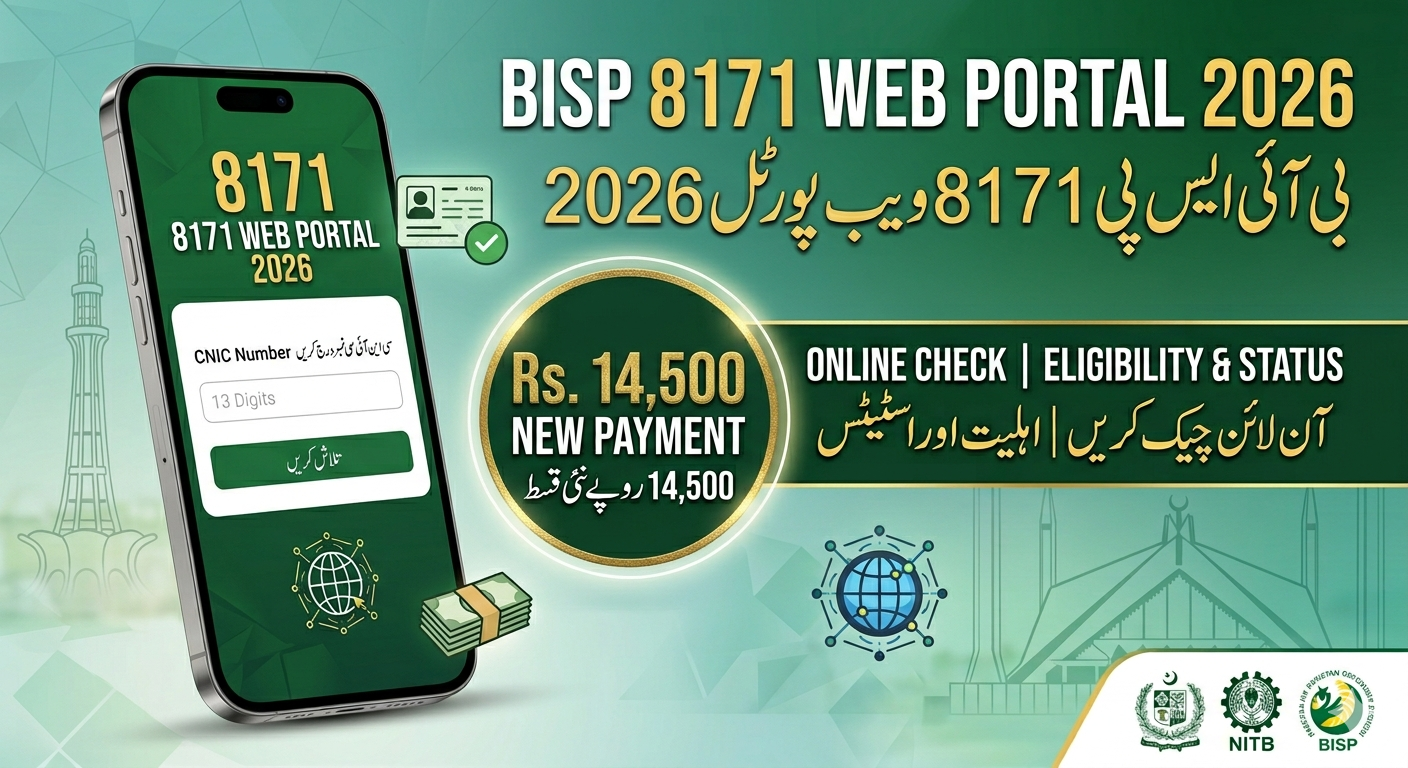
8171 Web Portal 2026
The government has officially increased the Benazir Income Support Programme quarterly installment to Rs. 14,500 for 2026. If you are one of the millions of beneficiaries relying on this financial lifeline, knowing how to track your funds instantly can save you from wasted trips to crowded cash centers. The updated 8171 web portal is now live, serving as the official digital gateway to verify your registration, track your payment status, and evaluate your household’s eligibility from any smartphone. This comprehensive guide walks you through the entire verification process, uncovers hidden hurdles like high PMT scores, and provides actionable solutions to secure your family’s financial relief.
Also read: پنجاب سولر پینل اسکیم 2026: آن لائن رجسٹریشن اور اہلیت کا مکمل طریقہ
Understanding the 8171 Web Portal Framework for 2026
The 8171 web portal is not just a basic lookup tool; it is the public interface of a highly sophisticated, data-driven social safety net. Developed by the National Information Technology Board (NITB) in coordination with the Benazir Income Support Programme (BISP), this platform pulls real-time data directly from the National Socio-Economic Registry (NSER) database.
Instead of waiting for physical letters or SMS alerts that often fall prey to local network delays, beneficiaries can directly query the central database. For 2026, the architecture has been streamlined to handle heavy server loads during peak disbursement weeks, ensuring that anyone with a valid Computerized National Identity Card (CNIC) can access their financial records within seconds.
The Role of the National Socio-Economic Registry (NSER)
The NSER acts as the backbone of the entire BISP ecosystem. It compiles socio-economic data from over 35 million households across Pakistan, evaluating asset ownership, household size, and income variables. When you enter your details on the 8171 web portal, the system matches your CNIC against this registry to determine your current socioeconomic standing.
Why Digital Verification is Essential in 2026
In previous years, transparency was a massive bottleneck for social welfare distribution. Beneficiaries frequently faced exploitation by unauthorized retail agents or middle-men demanding illegal deductions. Checking your status online before leaving your home gives you concrete proof of your active installment, ensuring you receive the full Rs. 14,500 without arbitrary cuts.
Step-by-Step Guide to Check BISP Rs. 14,500 Payment Online
Checking your cash status online does not require advanced technical skills. The 8171 portal is designed with a minimal interface that runs smoothly even on low-spec mobile devices and slower 3G or 4G data connections.
- Step 1: Access the Official Platform
Open your secure web browser and navigate directly to the official URL: https://8171.bisp.gov.pk/. Avoid third-party applications or unverified links found on social media, as they can compromise your personal data. - Step 2: Input Your Identification Details
Locate the dual input fields on the homepage. Carefully type your 13-digit CNIC number into the first field without including any dashes or spaces. Alternatively, if you have your recent NSER survey slip, you can enter the unique form number instead. - Step 3: Pass the Security Verification
Identify the 4-digit security captcha code displayed in the image directly next to the verification box. Type these exact digits into the designated field to prove you are a human user and not an automated script. - Step 4: Execute the Query
Click the green button labeled “Find Out” (معلوم کریں). The portal will instantly query the NSER database and refresh to display your household’s eligibility status and active balance on the screen.
How can I check my 8171 money by SMS?
If you live in an area with poor mobile data coverage, you can use the traditional offline SMS channel. Open your phone’s messaging application, type your 13-digit CNIC number without spaces, and send it directly to the shortcode 8171. Within a few minutes, you will receive a detailed text message from the official network confirming whether your Rs. 14,500 installment has been released to your account or if your profile requires a survey update.
Deciphering the 8171 Portal Status Responses
When the portal completes its search, it will return a specific text response. Understanding what these messages mean will tell you exactly what step to take next.
Green Signal: Eligible and Active
If the system displays a message stating that your household is eligible and your payment has been processed, your funds are secure. It will generally point you toward your regional partner bank—either Bank Alfalah or Habib Bank Limited (HBL)—or a designated campsite to collect your money.
Orange Signal: Incomplete Survey or NSER Update Required
This message indicates that while your CNIC exists in the system, your household data is outdated or incomplete. It means you must visit the nearest BISP tehsil office to undergo a fresh dynamic registry survey before any funds can be allocated to your name.
Red Signal: Ineligible (Jaanch Partal / High PMT Score)
This outcome means the system has flagged your profile as ineligible based on socioeconomic indicators. If you see the phrase “Jaanch Partal” (جانچ پڑتال), your data is currently undergoing a secondary administrative review, often triggered by changes in family structures or asset data linked to your CNIC at NADRA.
The PMT Score: The Real Metric Behind Your Eligibility
The operational heart of the 8171 web portal is the Proxy Means Test (PMT) score. BISP does not evaluate your financial need based on arbitrary criteria; instead, it uses a standardized mathematical formula that weights multiple indicators to generate a score ranging from 0 to 100.
To qualify for the primary Benazir Kafalat scheme and receive the quarterly Rs. 14,500 installment in 2026, your household’s PMT score must fall at or below 32.
- PMT Score 0 – 32: Highly Vulnerable / Extreme Need (Eligible for Full Kafalat & Taleemi Wazaif)
- PMT Score 32.1 – 60: Low to Moderate Income (Ineligible for Cash, Eligible for Taleemi Wazaif / Nashonuma)
- PMT Score 60.1 +: Stable / Middle to Upper Class (Completely Ineligible)
What is the PMT score for BISP 14500?
The exact cutoff score for the core cash transfer remains fixed at 32. If your score is 31, you will clear the automated checks on the portal. If your score climbs to 33 due to a registered asset, an international travel flag, or a mobile phone bill exceeding regional averages, the 8171 portal will automatically classify your profile as ineligible.
Resolving 8171 Portal Errors and Payment Failures
Even eligible beneficiaries run into technical roadblocking issues when attempting to withdraw their Rs. 14,500 cash. Knowing how to handle these errors will save you significant time.
Overcoming Biometric Verification Errors (Fingerprint Mismatch)
The most common point of failure at cash distribution points is biometric verification failure, often referred to as “Fingerprint Error.” This occurs when biometric devices fail to read the worn skin patterns of manual laborers or elderly citizens.
If your fingerprints fail to verify after multiple attempts, do not panic. Request the bank agent or BISP representative to log a formal complaint via the portal. BISP has a system in place where cases with repeated biometric failures are routed for manual verification via NADRA or alternative verification methods, allowing you to withdraw your funds through an OTP sent to your registered mobile number.
What to Do If Your Account Shows “No Balance” But You Are Eligible
If the 8171 web portal confirms your eligibility but the retail point-of-sale (POS) agent claims your balance is zero, you are likely dealing with a data sync delay or a corrupt agent. Check your portal screen carefully to verify the exact date of issuance. If the balance remains missing across multiple days, visit your local BISP Tehsil Office with a printed screenshot of your 8171 portal approval to initiate an internal tracking audit.
Registration and Dynamic Survey Strategy for New Applicants
If you have checked your status on the 8171 web portal and discovered that your household is not registered, you must follow the updated 2026 Dynamic Survey workflow. BISP has retired the old door-to-door paper surveys completely, replacing them with a digital-first approach.
- Step 1: Gathering the Required Documentation
Before stepping into a government office, ensure you possess your original, valid CNIC. For your children, you must bring their official NADRA Child Registration Certificates (B-Form). If you are a widow, ensure your marital status is updated to reflect your widowhood on your CNIC at a NADRA service center before applying. - Step 2: The Data Entry and Verification Process
At the Tehsil center, a data entry operator will interview you to fill out your household’s socio-economic profile. They will ask questions regarding your monthly utility bills, your living arrangements, family health status, and any assets you own. Be completely honest during this interview; the system runs cross-checks against vehicle registration databases, passport offices, and corporate payroll networks. - Step 3: Tracking Your Post-Survey Progress
Once the dynamic survey is complete, your data enters an automated verification cycle that takes roughly 60 to 90 days. During this time, your data is checked and your final PMT score is calculated. You do not need to make repeated visits to the physical office to check your progress—simply log onto the 8171 web portal once every two weeks to see when your score is finalized and your first Rs. 14,500 installment becomes active.
Actionable Insights for BISP Beneficiaries
Navigating government aid programs can be challenging, but keeping a few key practices in mind can make the process much smoother:
- Protect Your Sim Cards: Ensure the mobile phone number you register during your survey is legally issued in your own name. All critical official alerts, bank updates, and OTP codes are linked directly to this specific SIM card.
- Refuse Unlawful Deductions: The Rs. 14,500 payment belongs entirely to your household. If a retail POS merchant or local distributor attempts to charge a “service fee” or deducts Rs. 500 to Rs. 1,000 from your cash, immediately call the official BISP helpline at 0800-26477 to file a formal complaint.
- Keep Your NADRA Records Current: The NSER database relies heavily on NADRA records. If there is a death, marriage, or birth in your household, update your family tree at NADRA first, then request a dynamic survey adjustment at BISP to ensure your eligibility reflects your true household needs.
Frequently Asked Questions
How can I check my 8171 web portal eligibility online for 2026?
Visit the official 8171 web portal (https://8171.bisp.gov.pk/), input your 13-digit CNIC number into the primary query field, enter the 4-digit security image verification code, and press the “Find Out” button to see your current eligibility.
What should I do if the 8171 portal shows my PMT score is too high?
If your score exceeds 32, you will not qualify for the core cash program. However, if your financial situation has worsened since your last survey, you can visit a BISP Tehsil center to request a re-survey after a lock-in period of six months from your previous evaluation date.
Can I collect my BISP Rs. 14,500 payment from any commercial bank ATM?
No, you must collect your cash through the designated partner banks assigned to your specific province or region (typically Bank Alfalah or HBL). You can withdraw the funds via designated biometric retail points, campsites, or specialized biometric-enabled ATMs belonging to these specific partner institutions.
Is there any fee for registering a household on the 8171 web portal?
No, the entire application, registration, dynamic survey, and 8171 web portal lookup process is completely free of charge. The government does not authorize any private individual or agency to collect fees for assessing or altering your eligibility status.
Why does my 8171 portal status state “Jaanch Partal”?
This status indicates that your household data is undergoing an automated administrative audit. The system is verifying your information against national databases to ensure you meet all the socioeconomic criteria before officially updating your status to eligible or ineligible.